
By: Jeff Tropeano
You have the cloud contact center, AI chatbots, and a state-of-the-art CRM, yet your average handle time (AHT) is rising, and self-service containment is dropping.
If your agents are still toggling between ten different screens while a frustrated customer repeats their story for the third time, you don’t have a technology problem, you have a journey disconnect.
At COPC Inc., the organizations we work with usually come to us with the same recurring pains: fragmented data, blind escalations from bot to human, and technology that automates internal silos instead of customer outcomes. In this article, we’ll look at how to solve these pain points using Journey-Based Technology Design, a framework that aligns your tools with the actual path your customers take.
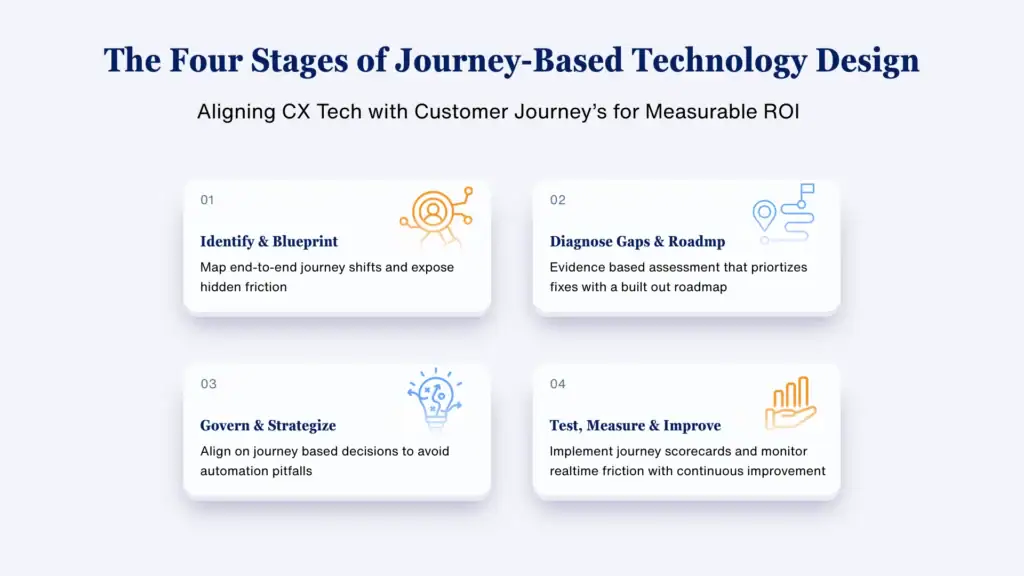
Stage 1: Identify and Blueprint the Customer Journey
The Challenge: Most organizations suffer from a significant visibility gap. They monitor departmental performance in silos yet have no line of sight into the friction points where customers actually drop off. You see rising handle times and frustration, but your internal dashboards remain green because they don’t measure the transitions between channels. When teams such as patient services and employee support see their work as isolated functions, the real experience remains invisible.
The Strategy: We move from departmental thinking to outcome thinking. Customers don’t think in terms of transferring to the billing department; they think in terms of resolving an inquiry. Using service journey blueprinting, we document the end-to-end path for high-value outcomes. In a recent project with a healthcare provider, bringing teams together to map journeys like eligibility and nursing escalation revealed issues that were invisible in departmental reviews: repetitive verification steps, missing context during handoffs, and inconsistent routing rules. Once the journey is documented, leaders finally see where they are asking customers to do extra work.
Learn More About Service Journey Blueprinting
Stage 2: Diagnose Gaps and Build the Roadmap
The Challenge: There is often a massive delta between how a journey is supposed to work and how it actually runs. This is where assumptions give way to evidence. When organizations invest in technology without this diagnosis, they often find that good tools produce bad results because they are layered on top of mismatched workflows, legacy tools, and unsynced data. Without a shared CX operating model, even the most hardworking teams cannot fix a fundamentally broken journey.
The Strategy: This stage replaces assumptions with evidence to build a realistic roadmap. For example, a North American telecom provider with over $9 million in unexpected bad debt discovered that the issue wasn’t agent effort, but a fragmented collection journey. Work spanned multiple facilities and legacy tools with no common thread. By diagnosing these gaps, we identified a practical sequence of fixes—clarifying roles and strengthening forecasting before changing digital tools. This ensures that your technology roadmap is prioritized by what will genuinely improve the journey and reduce loss.
Align Your Roadmap With the COPC CX Standard
Stage 3: Establish Journey-Based Governance and Decision Rights
The Challenge: The most expensive mistake an organization can make is automating a broken process. Without clear journey governance, IT and Operations often remain misaligned, leading to the purchase of CCaaS or AI platforms based on generic feature checklists. Many teams buy tools that add complexity or simply rebuild old problems in new platforms because they jumped to the “technology fix” before defining the journey requirements.
The Strategy: We establish decision rights that prioritize the journey over the tool. For a global healthcare provider, the journey work gave us a clear target for a new cloud contact center platform. Instead of comparing vendors on generic features, we rebuilt the selection process around real operational requirements: how each platform handled clinical handoffs, clinical escalation routes, and eligibility syncing. Technology delivers ROI only when the CX technology strategy is ready to support it, ensuring that automation solves the right problems.
Optimize Your CX Technology Strategy
Stage 4: Test, Measure, and Continuously Improve
The Challenge: Even the best-designed systems face performance decay or journey drift. Minor system updates, policy changes, or shifts in customer behavior can create new friction points that go undetected until customer churn or complaint volumes spike. In a mature model, the work is never “finished” just because a tool was launched; it must be monitored under real-world conditions.
The Strategy: We move beyond static, departmental metrics to implement Journey Scorecards. By monitoring full-path tracking patient acceptance rates, handoff patterns, and end-to-end resolution times, leaders can spot friction in real time. With the healthcare provider mentioned earlier, these scorecards allowed them to see exactly when new routing rules created friction, allowing them to adjust before outcomes suffered. This continuous loop of testing and learning ensures your CX ecosystem remains intentional and aligned, even as your business environment evolves.
Conclusion: Making Journey-Based Design a Way of Working
Journey-based technology design is not a one-time project; it is a fundamental shift in how you manage the intersection of operations and technology. The organizations that succeed treat journeys as living assets, revisiting their blueprints as new tools, policies, or partners enter the picture. They move away from measuring what was written in a vendor’s business case and start measuring what is actually happening to the customer.
In my work with clients, the most successful programs follow a consistent pattern: they start small, go deep on one high-value journey, and use that success as a proof point to build credibility. This approach provides clarity for technology teams and confidence for leadership. From there, the model scales. One journey at a time, the CX ecosystem starts to feel less chaotic and more intentional.
In Part 3 of this series, I will focus on the business case demonstrating how to link these journey-based decisions to real outcomes, including ROI ranges, reduced abandonment, and measurable improvements in customer satisfaction.

Jeff Tropeano
Executive Vice President, Global Technology Consulting, COPC Inc.
Jeff leads the firm’s worldwide practice by aligning customer experience strategy with digital transformation and AI. Known for a pragmatic, journey-first approach, he focuses on bridging the gap between high-level strategy and technical execution to ensure technology decisions drive measurable business outcomes. A dedicated thought leader and contributor to the COPC CX Standard, Jeff advocates for simplicity and transparency under the guiding principle that design should always lead technology.