

December 12, 2025
In every high-performing contact center, knowledge isn’t just stored; it’s shared, applied, and continually evolved. As customer experience environments grow more complex, effective knowledge management (KM) often differentiates smooth, confident operations from daily firefighting. It is increasingly shifting from static search to dynamic, context-aware knowledge surfacing, and even to conversational access to information.
At COPC Inc., we see knowledge management not as a piece of technology but as an operational discipline, one that connects people, processes, and systems to deliver measurable outcomes. When knowledge is managed well, it empowers agents, builds customer trust, and creates consistency that defines great brands.

COPC Consultant and KMI Certified Knowledge Manager Tonya Webber shares her top 10 best-practice insights, shaped by her work in some of the most mature, enterprise-scale customer experience and knowledge management operations. These include Fortune 500 companies, multi-billion-dollar healthcare leaders, and global consumer brands, and highlight what happens when these proven practices are overlooked.
1. Build a Knowledge Governance Framework That Actually Works
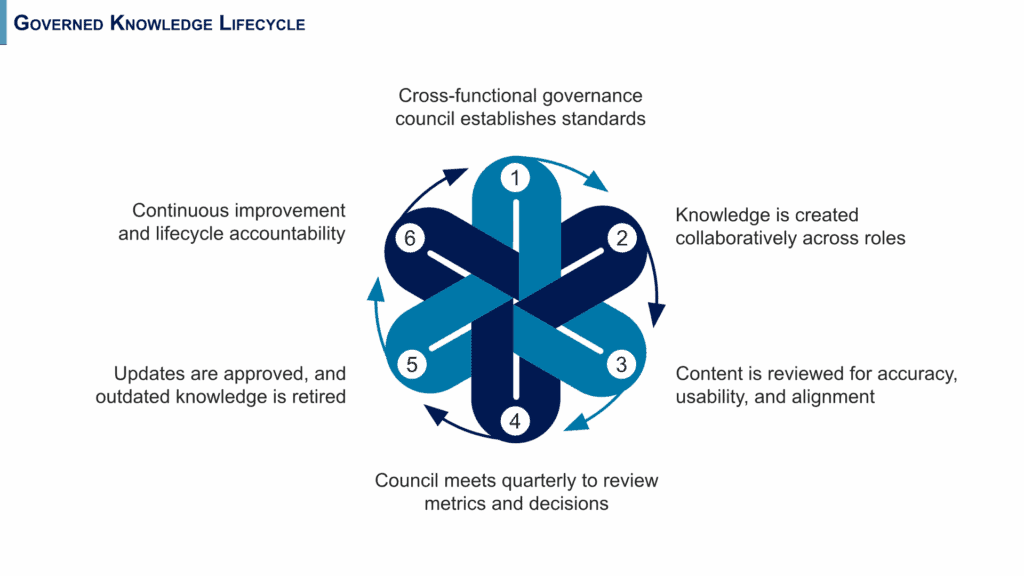
To build the right framework, you need to define ownership, establish version control, and develop a review cadence to ensure content accuracy and accountability.
A structured governance model sets the tone for how knowledge is created, reviewed, and retired. In mature operations, governance often sits with a cross-functional council (operations, training, quality, and knowledge management) that meets quarterly to review metrics and approve updates.
2. Tie Every Article Back to the Process It Supports
Every article should be directly tied to a process, policy, or standard operating procedure and be accessible within the workflow.
This alignment reduces ambiguity, supports compliance, and creates a clear audit trail, especially during COPC Inc. certification, where knowledge accuracy and consistency are assessed as part of operational rigor. The most mature environments take it further by embedding knowledge into the agent’s desktop, allowing relevant guidance to surface contextually within CRM or case-management tools, eliminating toggling and improving handle time.
3. Make Speed, Searchability, and Context-Aware Surfacing Your Superpower
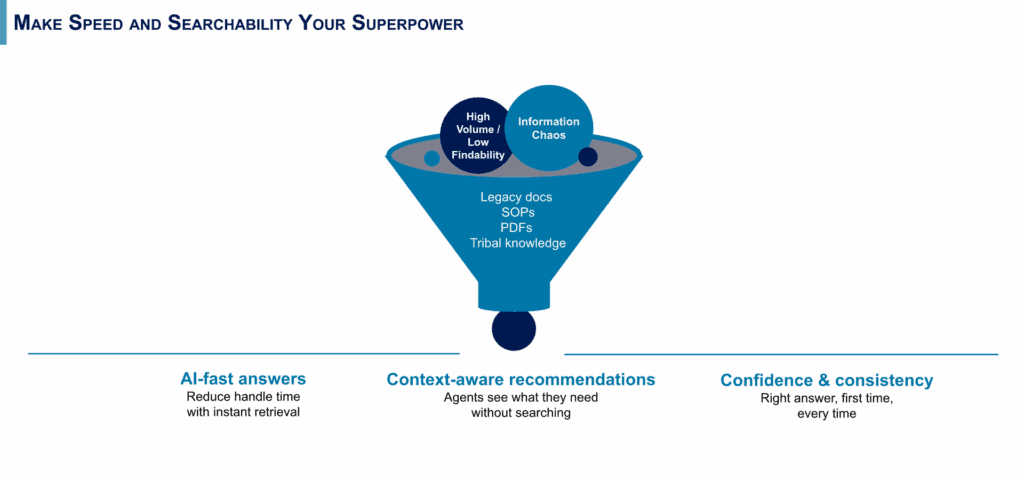
Time spent searching for information is time away from serving customers. The goal is not more searching, but less, giving agents the right answer in the moment without having to hunt for it.
Well-designed systems use metadata, tagging, and an intuitive structure to make information instantly accessible and set the foundation for the technology to present answers automatically based on context, channel, and interaction history. Platforms like NICE Enlighten and proprietary AI-enabled tools enable rapid search, context-aware recommendations, dynamic filtering, and even generative AI chat, reducing handle time and improving agent confidence.
4. Let AI Keep Knowledge Fresh
AI is transforming how knowledge stays current and how people access it.
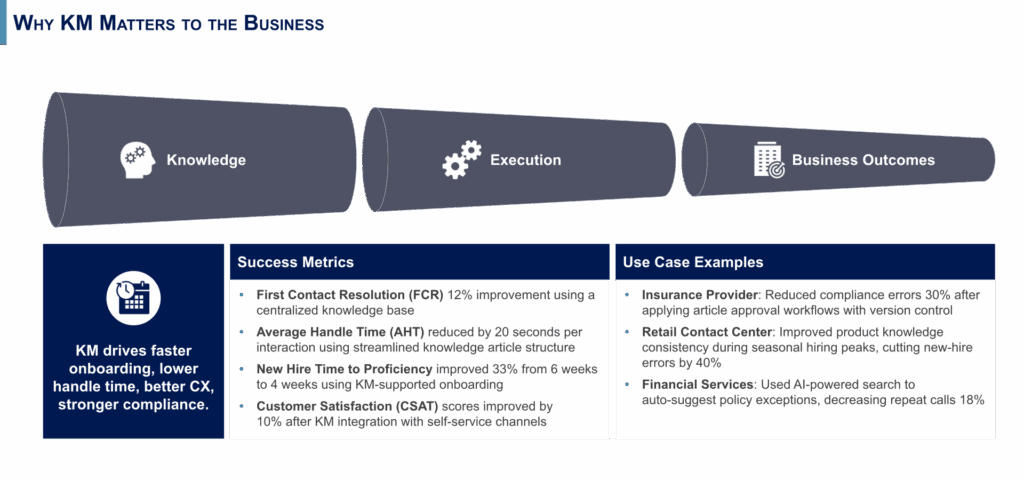
Machine learning can flag low-use content, suggest updates, and surface related articles. Generative AI experiences layered on top of a curated knowledge base can give agents and customers a conversational way to access content. Organizations using AI-driven knowledge management systems with governance have seen 20–40% reductions in issue volume (NICE) and 10–15% gains in accuracy (Brynjolfsson et al., 2023).
5. Connect Knowledge Across Every Channel
Consistency is critical when customers move between self-service, chat, and voice.
A unified knowledge base ensures agents and bots draw from the same source of truth, maintaining brand alignment and reducing rework. A key success factor is establishing central ownership while allowing localized views by channel or region. You can hear more in our webinar with livepro on aligning governance with platform design.
6. Turn Agents into Knowledge Champions
The best insights often come from the front line.
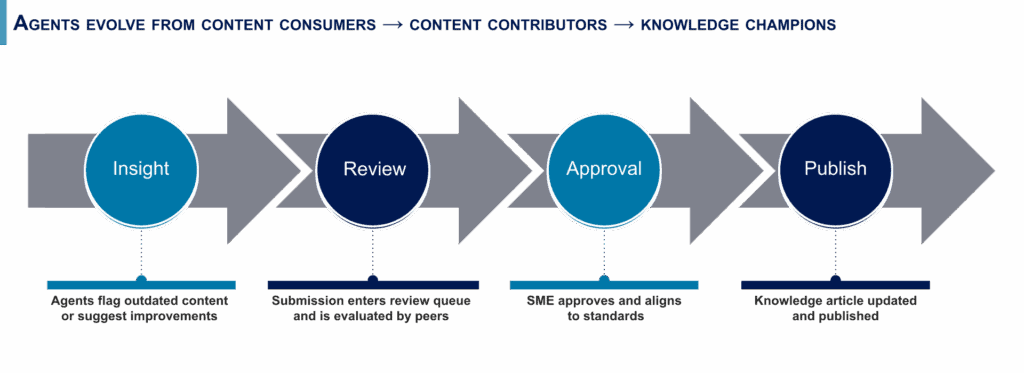
Encourage agents to flag outdated content or submit article ideas. In high-performing operations, these submissions go through a peer-review and SME approval workflow, giving employees a voice while maintaining quality control. This approach drives engagement and ensures knowledge evolves in step with real customer scenarios.
7. Measure What Matters
If you cannot measure it, you cannot manage it.
Leading organizations track usage, accuracy, feedback scores, and the impact on key KPIs, such as Average Handle Time (AHT) and First Contact Resolution (FCR). COPC recommends combining efficiency and quality indicators to show how well knowledge enables performance, not just whether it is being used.
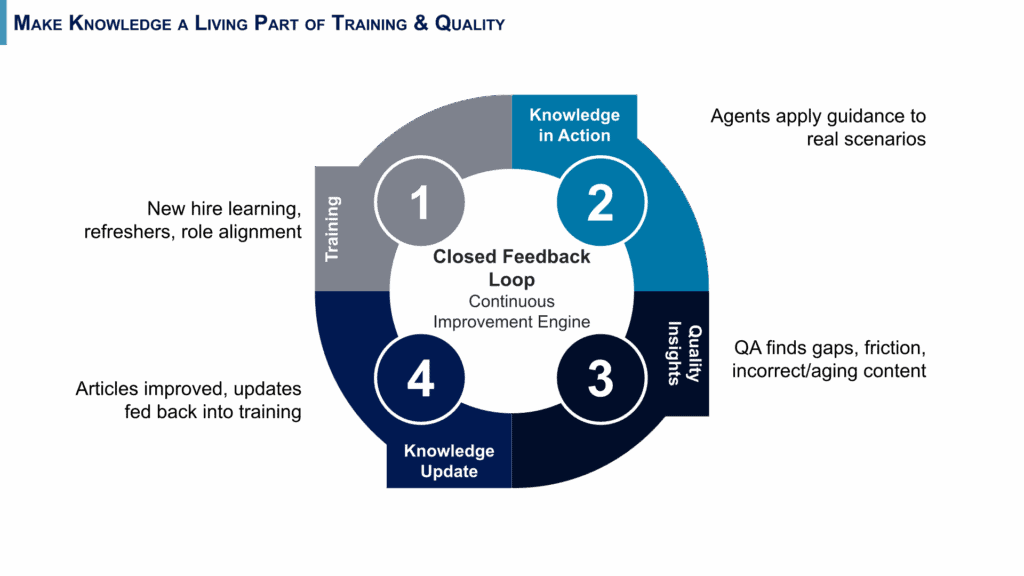
8. Make Knowledge a Living Part of Training and Quality
Knowledge should not exist in isolation.
By linking knowledge management with training and quality, organizations create a closed feedback loop; when quality assurance (QA) identifies a process gap, a knowledge article is updated; when training launches new materials, knowledge management is refreshed. This operationalizes continuous improvement and ensures front-line teams always have the latest information.
9. Tailor Knowledge to the People Using It
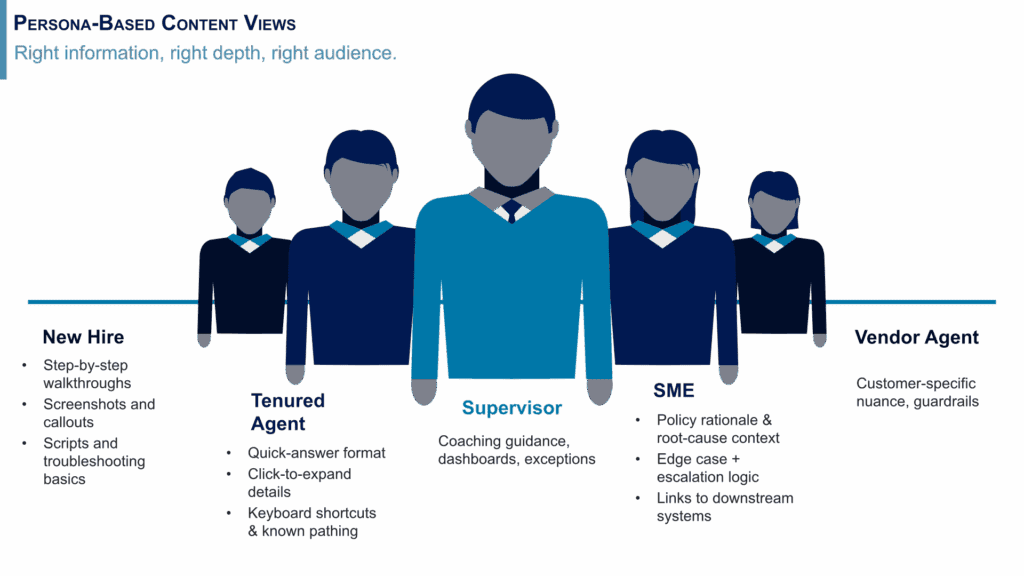
One size rarely fits all.
New hires, tenured agents, and specialists often require distinct levels of depth or context. Modern knowledge management systems enable role-based content views that scale across large or multi-vendor operations. This personalization reduces cognitive load, shortens onboarding, and ensures relevance without overwhelming users.
10. Audit, Update, Repeat
Knowledge is only as good as its last update.
Routine audits (at a minimum, quarterly) help ensure content remains current, easy to find, and aligned with evolving customer needs. COPC consulting and certification engagements evaluate knowledge management maturity by assessing governance, adoption, quality, and impact on performance, reinforcing that outcomes, not uploads, measure knowledge management success.
A Common Pitfall: Technology Before Governance
Even with these best practices in place, many organizations still stumble, not because of a lack of technology, but because of how it’s managed. Many organizations invest heavily in knowledge management technology before defining governance or adoption processes, resulting in duplication, conflicting content, and low user trust. COPC helps clients establish a Knowledge Governance Council, define KPIs, and embed knowledge management ownership into performance reviews to turn technology into a performance enabler.
Here are some technologies that we see have great potential:
- AI-assisted Knowledge Systems: Tools like NICE Enlighten XO, Bloomfire, and livepro streamline article maintenance, predictive search, and context-aware or generative recommendations that surface answers in real time.
- Embedded Knowledge Integrations: Embedding knowledge modules directly into CRM or agent-desktop environments ensures in-context guidance, driving faster adoption and measurable reductions in handle time.
- Integrated Feedback Loops: Feedback buttons and QA insights embedded in articles accelerate improvement cycles.
- Analytics Dashboards: Visualizing usage trends, feedback ratings, and aging reports help leaders prioritize updates that deliver impact.
- Generative AI Knowledge Assistants: Chat-based experiences that sit on top of your governed knowledge base, allow agents and customers to ask questions naturally and receive answers, while preserving linkages back to approved content.
Final Thoughts
At its best, knowledge management fuels performance. It builds operational confidence, eliminates friction, and ensures every employee delivers consistent, data-backed decisions. When knowledge management becomes a controlled process, governed, measured, and continuously improved, it shifts from an information function to a performance framework that strengthens every part of the customer journey.
The most successful knowledge management transformations happen when organizations stop treating knowledge as a library and start managing it as an operational system — one that connects people, process, and technology with purpose.
Learn more about COPC’s consulting services at www.copc.com.
Do you still have questions about implementing an effective knowledge management strategy? We’ve answered a few below.
FAQs
What is knowledge management in a contact center?
It’s the process of creating, organizing, and sharing information to ensure agents and customers get accurate, consistent answers fast.
Why is knowledge management important for CX operations?
It improves speed, accuracy, compliance, and customer satisfaction, while giving leaders visibility into how well processes perform.
How does AI improve knowledge management?
AI helps identify gaps, recommend updates, and deliver the correct information in real time, improving both efficiency and accuracy. Modern AI tools also power context-aware knowledge surfacing and generative chat experiences, so agents and customers can ask questions naturally and receive concise answers instead of searching.
How can you measure knowledge management success?
Track metrics such as usage, accuracy, feedback, and impact on AHT and FCR, and link them back to overall business performance.