

February 13, 2026
By: Jeff Tropeano
How to prove the ROI of CX transformation is now one of the biggest questions executives ask. Budgets are tight, AI expectations are high, and leaders want a clear, defensible case before they fund the next project. In my work leading Technology Consulting at COPC Inc., I see that the ROI of CX transformation rises or falls on one thing: how well technology aligns with the customer journey.
In Part 1 of this series, I talked about the hidden disconnect between departmental silos and CX. Part 2 continued that discussion, revealing a 4-step approach that solves the pain points associated with those disconnects. This article breaks down where value is lost in day-to-day operations and how Journey-Based Technology Design turns that loss into a measurable return.
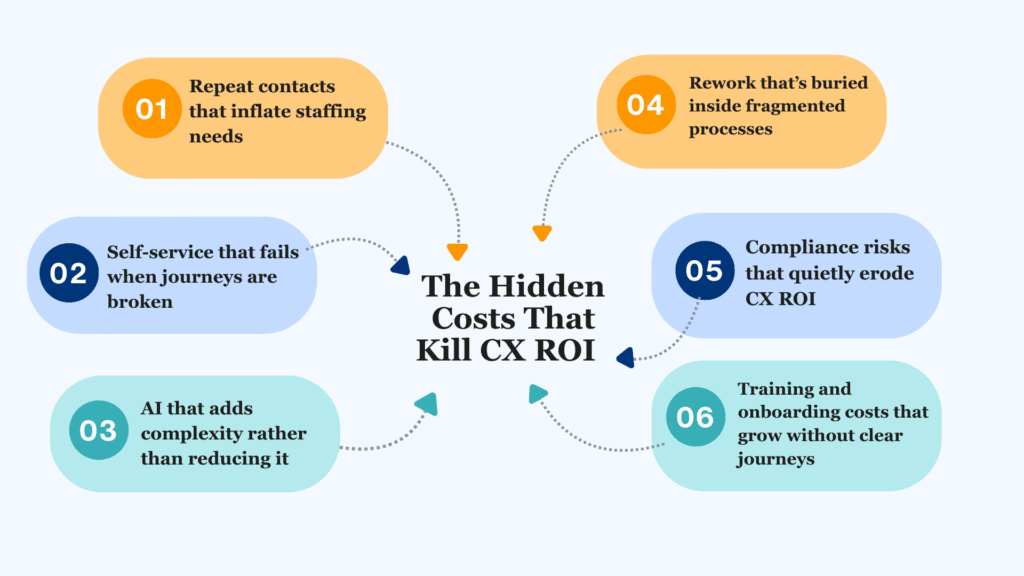
The Hidden Costs That Kill CX ROI
If organizations are not achieving the expected ROI from CX transformation, the problem is rarely the platform itself. It’s the operational friction created by unclear or fragmented journeys, systems, and teams. These hidden costs drain budgets long before technology has the chance to deliver returns.
1. Repeat contacts that inflate staffing needs
Unclear or fragmented journeys force customers to reevaluate when something is missing, inconsistent, or not completed the first time. This hidden rework increases contact demand and drives up staffing requirements more than most leaders realize.
The impact becomes obvious when organizations streamline the journey and give agents consistent guidance. In COPC engagements, we see this most clearly with AI-enabled, real-time agent guidance platforms used in contact center environments.
Across multiple deployments, these platforms report that when journey steps are aligned, and agents follow a consistent, proven path, organizations see:
- A 76% reduction in two-hour repeats
- A 56% reduction in two-day repeats
- A 47% reduction in seven-day repeats
These results did not come from buying another tool. They came from cleaning up the journey and helping every agent follow the same playbook.
2. Self-service that fails when journeys are broken
Most self-service programs struggle for simple reasons: customers hit dead ends, content doesn’t match their real questions, or the handoff to a human feels like starting over.
An AI-first support automation platform used in customer service environments shows what happens when you fix that. In environments where the customer journey and knowledge content are clearly defined, these platforms report self-service deflection rates above 90%.
Those results are not about a “smarter bot.” They come from doing the journey work first, so the bot knows which problems it should solve, which steps to guide, and when to escalate.
3. AI that adds complexity rather than reducing it
Many organizations hope AI will fix broken CX, but the opposite happens when journeys are unclear. In complex, inconsistent environments, customer service calls get longer, attrition rises, and onboarding still takes 4 to 12 weeks.
An AI copilot designed to support contact center agents reports that once organizations streamline journeys and workflows, they see:
- About a 35% handle-time reduction
- Around 25% faster onboarding
- Roughly a 5% lift in first contact resolution (FCR)
- Around a 10% improvement in customer satisfaction and Net Promoter Score (CSAT/NPS)
The technology did not solve the problem on its own. Results improved only after the journey was simplified and the AI could guide agents through a consistent process.
4. Rework that’s buried inside fragmented processes
Rework is one of the quietest ways the ROI of CX transformation gets eaten up. In our assessments, we regularly see the same patterns:
- Different teams perform the same step in different ways.
- Information is captured twice because systems are not connected.
- Simple changes (like an address or plan update) trigger multiple tickets and handoffs.
None of this appears on a technology invoice, but it drives up handle time, training effort, and error rates. Journey-Based Technology Design cuts this waste by standardizing how work flows through the organization, clarifying who owns each step, and making sure data is captured and corrected only once.
5. Compliance risks that quietly erode CX ROI
Regulated industries feel this the most. Healthcare teams have to protect patient data under the Health Insurance Portability and Accountability Act (HIPAA). Payments and financial services teams operate under the Payment Card Industry Data Security Standard (PCI DSS) and other security rules. When each channel or team uses a different process for identity checks or payment capture, you end up with gaps that are hard to spot until an audit or an incident.
A customer experience security and authentication platform is designed to make those steps consistent. It uses the customer’s smartphone and a patented privacy-preserving authentication architecture that allows callers to securely authenticate and complete sensitive actions without exposing raw data to agents. It can also help remove contact centers from the PCI DSS scope for voice and digital payments, reducing both costs and compliance risk over time.
The return is straightforward: fewer inconsistent processes, less manual effort to demonstrate compliance, and a lower risk of costly security or privacy issues for journeys that handle HIPAA and PCI-sensitive information.
6. Training and onboarding costs that grow without clear journeys
When journeys are not clearly defined, training often becomes tribal knowledge. New hires learn “how Sarah does it” instead of how the journey is supposed to work—making onboarding slower and coaching harder.
An AI-based coaching and simulation platform used for CX agent training shows what happens when workflows are clear enough to turn into repeatable practice:
- New hire training time and training resource costs are reduced by more than 50%.
- Agent performance improves by about 7–9% through automated, data-driven coaching.
- Customer satisfaction (CSAT) scores increase by around 12–15% as agents hit the floor better prepared.
Those gains happen because the customer journey and supporting processes are defined clearly enough to be simulated, coached, and reinforced the same way every time.
Turning Journey Work Into a Repeatable ROI Engine
The examples in this article all show that the ROI of CX transformation comes from removing friction in your journeys, aligning people and processes, and then letting technology do its job. That is the foundation of the COPC Customer Experience (CX) Standard and the basis for our consulting work with organizations seeking measurable, defensible results from their technology investments.
From my experience, the organizations that succeed start small. They select one high-value journey, map it thoroughly, fix the issues that slow it down, and use that proof point to guide future investments. With the right structure in place, the journey becomes a repeatable ROI engine.

Jeff Tropeano
Executive Vice President, Global Technology Consulting
As Executive Vice President of Global Technology Consulting at COPC Inc., Jeff Tropeano leads the firm’s worldwide practice by aligning customer experience strategy with digital transformation and AI. Known for a pragmatic, journey-first approach, he focuses on bridging the gap between high-level strategy and technical execution to ensure technology decisions drive measurable business outcomes. A dedicated thought leader and contributor to the COPC CX Standard, Jeff advocates for simplicity and transparency under the guiding principle that design should always lead technology.