

March 31, 2026
By Jeff Tropeano
These days, saying you’re “using AI” in your contact center is like saying you’re “using electricity.” The question isn’t whether you have it. The question is what you’re doing with it, and whether it’s actually making your customer’s life better. After years of working with service organizations across industries, I’ve noticed a pattern. The companies that struggle aren’t the ones without tools. They’re the ones without a framework for understanding where they are and what “better” actually means.
At COPC Inc., we define maturity not by the tools you buy, but by the service journey you enable. To move forward, you need a framework that reflects the reality of a service organization moving from simple sorting to complex, autonomous coordination.
The Five Stages of AI Maturity
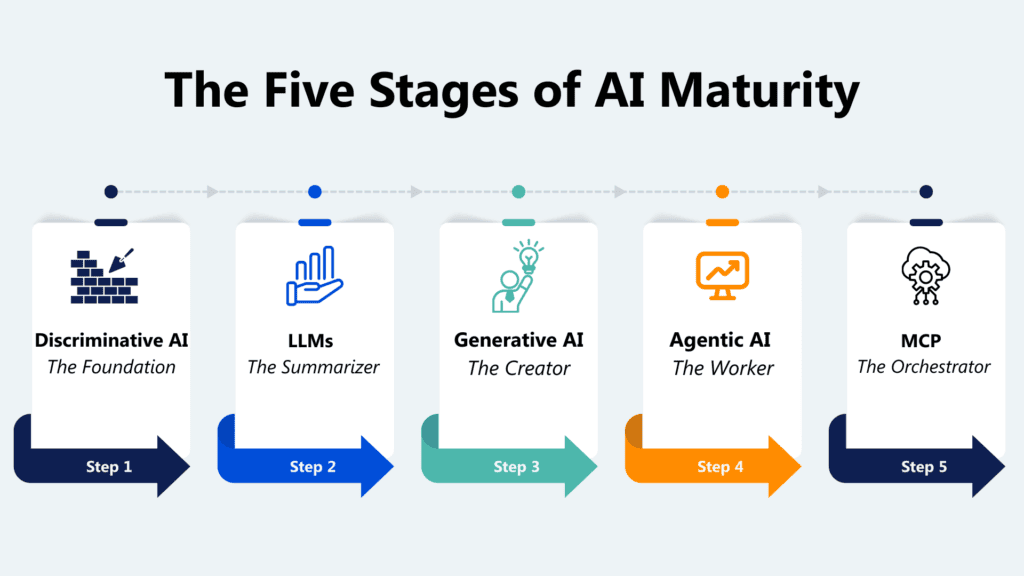
Maturity here is about the service journey you enable for your customers. Each stage builds on the last, and skipping ahead without the foundation is how you end up spending a lot of money to confuse your customers faster.
1. Discriminative AI: The Foundation This is table stakes. It covers basic classification, routing, and intent scoring. If you aren’t doing this, you are effectively sorting mail by hand in a digital age. At COPC, we call this fundamental demand management. You cannot build a sophisticated system if you can’t get the ticket to the right desk. The audit check here is simple: is your data clean enough to route 95% of contacts correctly? If you are still relying on customers to self-select from a dozen IVR options, you aren’t ready for the next level.
2. LLMs: The Summarizer This stage involves language generation, wrap-up notes, and transcription. It is where most organizations currently find themselves stuck. They deploy the tools, but those tools often have the memory of a goldfish. Because they don’t retain context across channels or sessions, the ROI remains hidden in productivity gains that are notoriously difficult to prove on a P&L. Unless this stage is integrated into a strategy where the AI actually feeds your knowledge base, it is just a faster way to generate bad notes. By the way, most organizations are at this point. (More on this later.)
3. Generative AI: The Creator At this level, we move into multi-turn dialog and simulation-based coaching. While this gets interesting, it is dangerous without clean data. If your knowledge base is outdated, your generative bot is just confidently hallucinating lies to your customers. This is the stage where the “People Simulation” trap is most tempting. Companies spend months trying to make a bot sound more empathetic when they should be focused on making it more accurate.
4. Agentic AI: The Worker This is the breakout moment. These are tools that learn, remember, and act autonomously. This system doesn’t just answer a question; it fixes the problem. It learns from feedback and adapts to edge cases. It functions more like a team member than a software license. Reaching this stage requires a shift from traditional quality assurance to AI governance. You don’t just check the code. You audit the outcomes like you would a human employee.
5. MCP: The Orchestra Model Context Protocol represents a future state of interoperable agents coordinating across systems. This is a protocol shift where agents negotiate with other agents to optimize outcomes across your entire tech stack. This is the ultimate service blueprint, where the customer moves through the journey and the seams between departments finally disappear. Your billing agent talks to your shipping agent, and the customer never has to repeat their story.
The Valley of Death Between Stages
Most companies stall between the second and third stages. They deploy copilots but don’t integrate them into the actual workflow. They launch bots but don’t measure if the customer actually received help. This creates a value gap where the cost of the tech is visible but the benefit is purely anecdotal.
The jump to Agentic AI is even harder because it requires you to surrender some control to gain speed. In a traditional environment, we script every possible interaction. In an agentic environment, we set the guardrails and the goals, then let the system find the best path. This requires a level of trust that most organizations haven’t built yet. You need a process for onboarding the AI as if it were a new hire, complete with constant feedback loops rather than a one-time installation.
The companies getting this right treat AI onboarding the way they treat employee onboarding: constant feedback loops, escalation paths, performance reviews. Not a one-time installation followed by hope.
Two Questions That Reveal Your Real Maturity Level
There is a simple way to find where you live on this scale. First, look at Context. Does your AI know who the customer was yesterday? If every interaction starts from zero, you are stuck in the early stages regardless of how “smart” the bot sounds.
Second, look at Learning. Does the system improve over time without you having to rewrite the code? True maturity means the system identifies its own friction points and surfaces them for the team to address.
We are moving from a world of static apps to dynamic agents. The companies that navigate this successfully won’t just have smarter tools. They will have a culture that learns faster than the competition.

Jeff Tropeano
Executive Vice President, Global Technology Consulting
As Executive Vice President of Global Technology Consulting at COPC Inc., Jeff Tropeano leads the firm’s worldwide practice by aligning customer experience strategy with digital transformation and AI. Known for a pragmatic, journey-first approach, he focuses on bridging the gap between high-level strategy and technical execution to ensure technology decisions drive measurable business outcomes. A dedicated thought leader and contributor to the COPC CX Standard, Jeff advocates for simplicity and transparency under the guiding principle that design should always lead technology.