

Behind the scenes at COPC Inc.
By Judi Bolden
A good question landed in the COPC Inc. global team thread a few weeks back, the kind that deserves more than a quick reply. Ian Aitchison, CEO of COPC Asia Pacific, was asked by a client a deceptively simple question: when you’re hiring a mix of full-time and part-time agents, how do you train the part-timers well? Ian decided to ask the collective global team to chime in on what they see working best in all regions.
The responses came back quickly from people with direct experience. They were too valuable to keep internal, so here is the conversation, lightly edited for brevity.
Schedule and Methods Matter
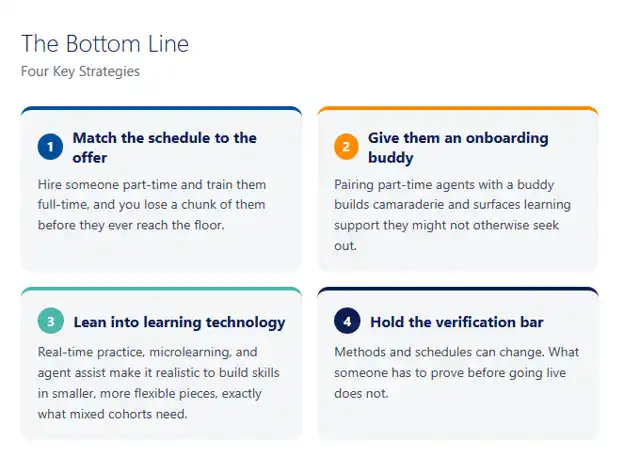
My answer to Ian came down to two important strategies.
First, match the training schedule to the job you hired people into. When someone signs on for part-time work, requiring full-time training breaks the deal on day one. That shows up in two ways: some new hires don’t turn up at all, and more drop out partway through than those who signed up for full-time schedules.
The fix is straightforward. Run part-time training for part-time hires. More about methods in a moment, but the teams I’ve seen schedule part-time onboarding for part-time hires get better show rates, less early attrition, and stronger uptake on part-time offers from strong candidates.
Second, classroom learning methods are largely boring and unnecessary. For part-time and full-time hires alike, there are newer approaches that work and help people build skills as they go instead of front-loading everything into academic-style training. Newer methods marry theory with practice, reinforcement and practical demonstration of skills mastered.
What It Looks Like in Practice – Even Without Newer Methodologies
Paula Feit, VP of Consulting, had done exactly this at MoneyGram in her prior role.
We had part-time classes for part-time hires and full-time classes for full-timers. They ran Mon-Fri, 4 hours a day, with evening or daytime schedules, and we doubled the training length to accommodate the full program. It worked really well for our part-timers. They still had to commit to the part-time training schedule during the hiring process.
Paula Feit, VP Consulting, COPC Inc.
The detail that makes it work: the same content as the full-time program, just stretched over a longer calendar and scheduled for when part-timers wanted to be there. And the commitment got locked in at hiring, not sprung on people later. That’s why new hires are more likely to stay with you.
The Cheapest Retention Tool Going
Monique Röhrman, VP of Certification Services, agreed and added an additional best practice she’s seen work repeatedly.
A buddy is assigned to the new employee. This is done regardless of whether they work full or part-time. This should be a peer, so at the same level. The intent is to understand issues in whatever shape or form early on, so that actions, if possible and needed, can be taken.
Monique Röhrman, VP Certification Services, COPC Inc. EMEA Region
It works especially well with new hires, who will tell a peer something is wrong long before they would raise it with a manager. A buddy is a peer at the same level, there to catch the small stuff early: someone going quiet or stuck on something basic, before it ever shows up in a metric.
Technology Caught Up: What’s Possible Now
Jeff Tropeano, EVP of Technology Consulting, leaned in on not relying on old ways of training when the technology is new.
Two COPC partner platforms came up. Zenarate and SymTrain both let agents practice realistic customer interactions in their own time. In Jeff’s words: “A part-time agent can run through ten simulated calls by whatever time is scheduled on demand. This has a side benefit of not requiring training staff hours.” The platform scores them, coaches them in the moment, and ramps the difficulty as they improve. SymTrain has reported 50 to 70 percent reductions in training time and 50 percent faster speed to proficiency versus traditional methods.
The other piece is microlearning. Centrical, another COPC partner, delivers 5- to-10-minute modules in small, flexible chunks instead of one long day.
Jeff’s bigger point stuck with me:
I think the broader shift is from measuring training completion by hours in the classroom to measuring it by demonstrated proficiency. A part-time agent who can pass an AI simulation assessment at the required threshold is ready for the floor, regardless of whether they trained for 80 hours or 40.
Jeff Tropeano, EVP Technology Consulting, COPC Inc.
Do These Best Practices Align with Guidelines in the COPC CX Standard?
Fair question. The answer: YES! All of what is said herein supports the COPC Customer Experience (CX) Standard.
Items 3.2 and 3.3 of the COPC CX Standard, Release 8.0, spell out what a training program has to deliver: cover the minimum capabilities for the role, define the methodology, verify trainees before they handle live interactions, and measure training quality.
On training method format, the COPC CX Standard is deliberately quiet. No required classroom, no set number of hours, no rule that part-timers and full-timers train the same way. Classroom, on-the-job, simulation and microlearning are all fair game, as long as people clear the required skills bar.
There is one clause that matters here:
All staff performing similar roles are verified in the same manner no matter what their status.
COPC CX Standard, Release 8.0, Item 3.3
Same role, same verification. Schedule, method, and duration can all flex. The bar an agent clears before going live cannot. Every approach above is in line with the COPC CX Standard.

Training: Best Practices for Customer Experience Operations
This course centers on the COPC Customer Experience (CX) Standard, which companies worldwide have used for 27+ years to manage and improve their contact centers and CX operations.
Talk To COPC
If your training isn’t doing what you need for a mixed full-time and part-time workforce, a conversation with one of our consultants is a good place to start.
Related: COPC CX Standards · COPC CX Training · COPC CX Technology Consulting

Judi Bolden
Vice President, Performance Improvement, COPC Inc.
Judi brings three decades of global customer experience (CX) leadership, expertly combining in-depth process assessment with actionable, results-driven solutions anchored in Lean Six Sigma contact center methodologies. As a recognized thought leader and frequent industry speaker, she is highly sought after by COPC clients to identify high-impact, low-effort opportunities, assess ROI, recommend strategic actions, and guide internal teams through successful implementation. Her broad expertise encompasses quality assurance, VMO lifecycle management, change management, vendor sourcing, program management, and transformational initiatives, making her a trusted advisor for organizations seeking measurable performance improvement.