

October 24, 2023
In our previous article, we examined how coaching customer satisfaction (CSAT) to a number may lead to wasted time and effort, employee dissatisfaction, and difficulty in improving CSAT results. This month, we will discuss what we should be doing instead, uncovering the key drivers of CSAT.
CSAT as an Output Metric
First, we need to agree that CSAT is an output metric in the contact center, not an input. For example, say you want to earn more money per year. Making more money could be quantified as a metric, but it’s an output, not an input.
For instance, if you talked to a recruiter or financial advisor and said your goal is to earn more money, they should not simply look over your resume or your assets and liabilities and tell you, “Great! To do that, you need to start incrementally earning more money, and over time, you will get to the total you want.” If they did, you would look elsewhere for help.
The same is true when a supervisor tells an agent to increase their CSAT by making it a bit higher week over week (even ignoring the statistical validity of the measure; it’s just not a helpful plan). Instead, what you would expect from a recruiter or a financial advisor and what agents should expect from a supervisor is a plan. What tangible actions can you take to improve your situation? That’s what we will talk about in this article.

Measuring the Customer Experience
Get an accurate view of performance and actionable data that will ultimately lead to sustained improvements in the customer experience.
Understanding the Relationships: Inputs and Key Drivers
The plan for improving something like CSAT requires understanding the relationship between things such as the inputs and the key drivers of CSAT. These are typically observable as other performance metrics and agent behaviors. Before we get into some of the math, I’ll use an example that makes the reasoning behind this easy to understand.
Let’s say we want to predict which players starting a professional basketball career are the most likely to be successful. We might think about a few stats we know that could help us.
A player’s height probably matters; we may reasonably assume that as their height increases, their chance of success also increases. Player height and increased chances of success is a relationship or correlation between variables. A player’s hand size also might matter. Again, we could test this and see if it correlates with success.
However, there is also probably a relationship between height and hand size, which may be substantial (meaning, as one variable changes, the other changes in a very predictable way). When you see this in your inputs, you must be careful.
It could be that only one of the variables predicts your output, and the other one predicts your additional input. To address this, we can use multiple regression. This technique considers numerous variables and eliminates inputs that seem to contribute to the prediction solely because they closely resemble another input.
The Role of Multiple Regression
In this case, using multiple regression, we might find that only hand size matters. Hand size is close enough to height that we do not need that variable, and perhaps basketball players with a greater hand size for their height have more success.
However, hand size alone probably isn’t very predictive (either that or basketball scouts are grossly overpaid). Many variables come into play: previous performance, injuries, decision-making and teamwork. The more of these we correctly account for, the more predictive our model becomes and the more confident we can be about the probable outcomes.

You may also like:
Choosing Between CSAT, NPS or CES: Why it Does Not Matter
Applying the Approach to Behaviors
We can use the same approach with behaviors. Sticking with basketball, we might check if dribbling improves accuracy before shooting a free throw. How many hours of sleep before a game is best? How many passes before a shot leads to the most excellent chance of making a basket? These are all observable, coachable things you could put into a player’s improvement plan. Each would help them more than saying, “You need to get out there and score more points.”
Bringing this back to the math and contact centers, your CSAT (or any output) is a dependent variable—it depends on the performance of other variables. Your other metrics, such as response time, average handle time (AHT), escalation rate, etc., may be independent variables; they may predict CSAT, and you can control them more.
There are also likely behavioral changes an agent can make that will improve their chances of a positive outcome. Did the agent use the right resources? Did they probe to identify the reason for the contact? Did they offer all reasonable solutions? Did they explain the next steps?
Identifying Key Drivers of CSAT
You need to know which of these factors is important to your customers. A key driver survey, which measures overall satisfaction and satisfaction with what customers think is critical overall, can tell you about the factors on which to focus.
Also, analyses of existing customer experience data using multiple regression, CART, chi-square, or other techniques can help determine which factors genuinely influence overall satisfaction and which are the most important. Choosing your key drivers is similar to taking various stats from basketball players and figuring out which ones predict success.
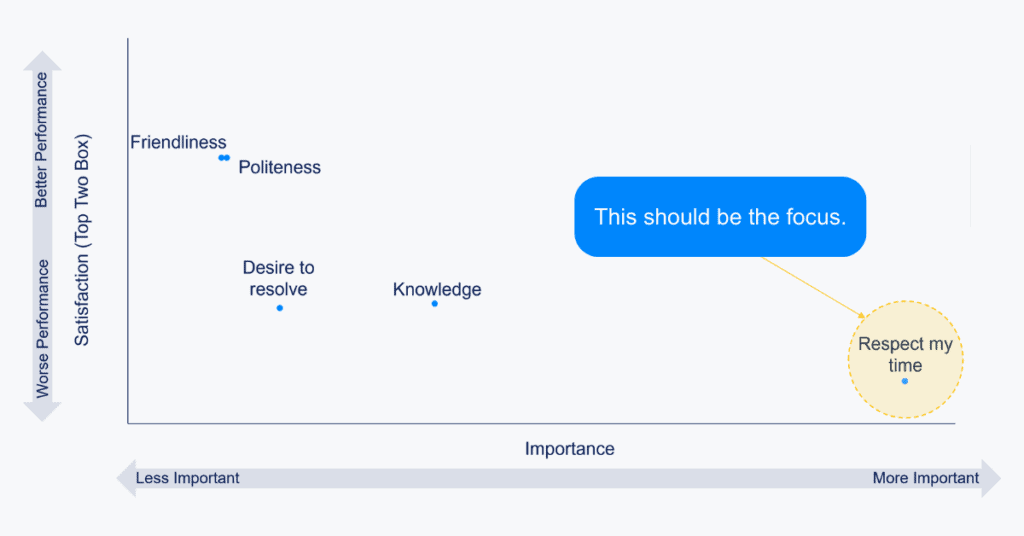
In this example, COPC found that “Respect my time” was far above the key driver of satisfaction, while the client had equally weighted all the factors present.
Once you know these factors, a robust quality program becomes central to your ability to manage customer satisfaction. Not only will you know which factors are essential at a program level, but this knowledge also makes coaching more manageable and vastly more effective. Starting with the correct information is critical.
In the example above, this would mean coaching issues related to respecting the customer’s time before worrying about other areas for improvement.
How We Can Assist Your Journey
While I hope this article explains some of the process and why it’s important there are many steps and nuances to conducting an effective key driver survey and analysis. If your interest is piqued, we have helped many companies like yours navigate through identifying the right questions to ask your customers, analyzing the data, and creating effective quality programs that drive higher CSAT. If you would like COPC guidance, we would be happy to help.

Author
Nathan Van Allen, Consultant at COPC Inc.